


Refugee Sponsorship: Act Now
Why Sponsorships Are Limited—and What You Can Do
We deeply value the compassion and generosity of our Catholic community, parishes, and the public who reach out with the hope of sponsoring refugees through the Private Sponsorship of Refugees (PSR) Program. While our desire is to respond to every request, we are currently limited in the number of sponsorships we can support due to recent federal policy changes.
These changes were introduced by Immigration, Refugees and Citizenship Canada (IRCC) and affect all Sponsorship Agreement Holders (SAHs) across Canada.
Understanding the Global Cap
The Global Cap is the total number of allocations that is given to all Sponsorship Agreement Holders (SAH) in Canada.
Each SAH gets different number of spaces given to them from IRCC.
IRCC has introduced a three‑year Global Cap and Levels Reduction Plan (2026–2028).
On November 25, 2025, IRCC informed the SAH Association that the Global Cap for 2026 would be reduced to 5,000 people nationwide. This represents a 54% reduction from 2025 — which was reduced by 20% in 2024.
Global Cap by Year:
2024
13,500
2025
10,800
2026
5,000
*2027
To be determined
As a result of this significant decrease, the Diocese of Hamilton received far fewer sponsorship spaces for 2026. This directly impacts our ability to respond to the many families hoping to reunite with loved ones through this life‑saving program.
*The allocation numbers determination is under the authority of the immigration minister. This means that the Minister can increase the allocation at any given point of the fiscal year which is different than the level plans and can be changed by strong advocacy initiatives.
Overall Reduced Immigration Levels Plan (2026-2028)
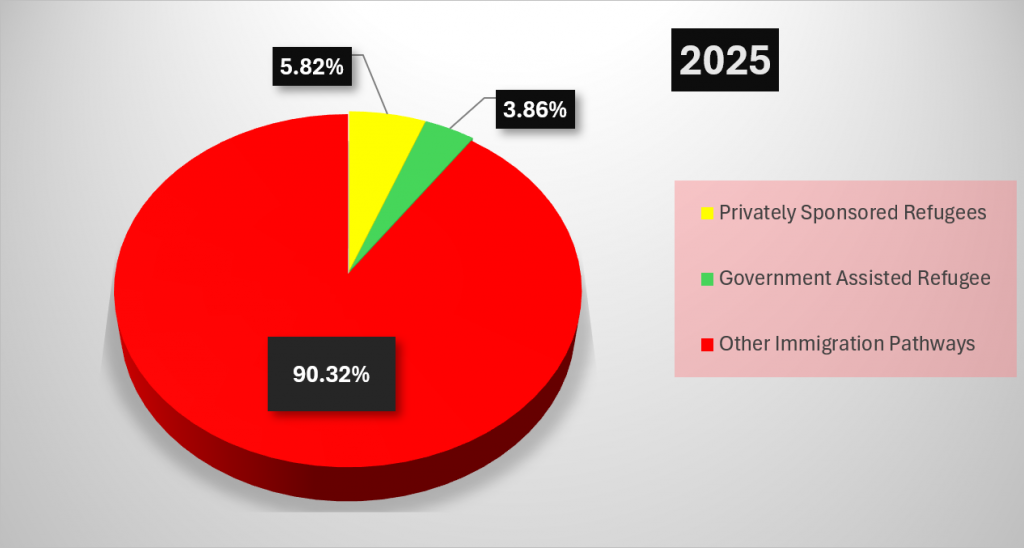
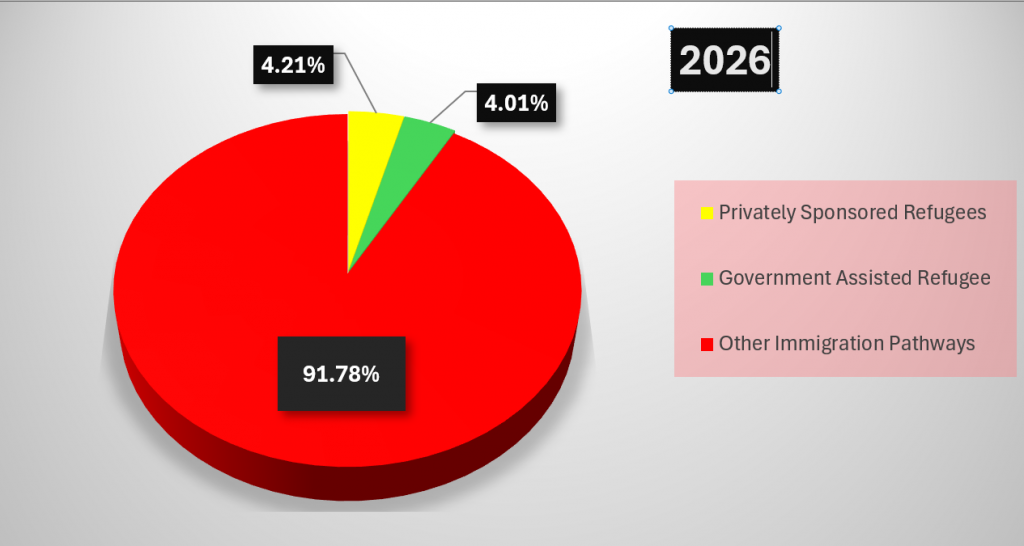
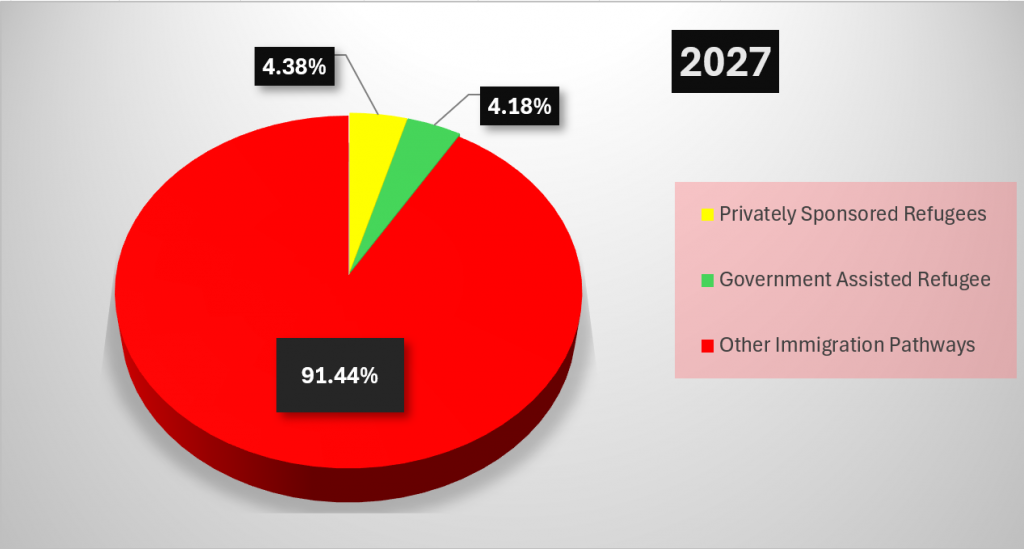
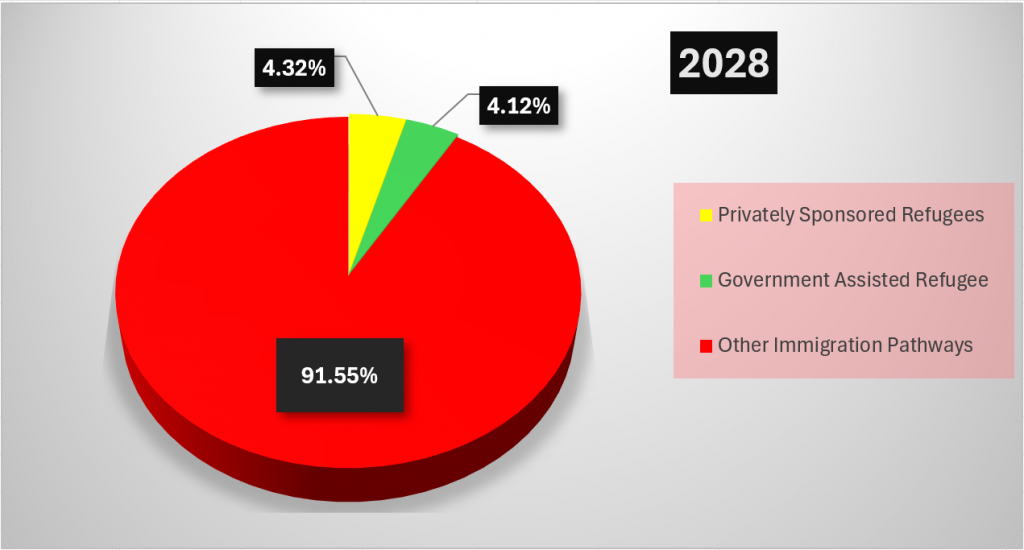
The Immigration Levels Plan encompasses all immigration streams. Alongside reducing the global cap, Immigration, Refugees and Citizenship Canada (IRCC) has also lowered its immigration targets, including those related to refugee admissions, which will affect the number of refugees arriving in Canada each year.
| Year | Total Immigration | GAR | PSR | Total Refugees | Other Immigration | Refugee Share |
|---|---|---|---|---|---|---|
| 2025 | 395,000 | 15,250 | 23,000 | 38,250 | 356,750 | 9.7% |
| 2026 | 380,000 | 15,250 | 16,000 | 31,250 | 348,750 | 8.2% |
| 2027 | 365,000 | 15,250 | 16,000 | 31,250 | 333,750 | 8.6% |
| 2028 | 370,000 | 15,250 | 16,000 | 31,250 | 338,750 | 8.4% |
Additional IRCC Restrictions Affecting Sponsorship
In addition to the reduced Global Cap, several other federal decisions further limit sponsorship opportunities:
- No New Sponsorship Agreement Holders (SAHs) for 2026:
IRCC has paused applications for new Sponsorship Agreement Holders (SAH) until further notice. This means no new organizations can become SAHs in 2026, further restricting options for prospective sponsors.
- Extended Pause on Groups of Five and Community Sponsors:
IRCC has extended the temporary pause on new applications from Groups of Five and Community Sponsors until December 31, 2026.
This pause was first introduced on November 29, 2024, until December 31, 2025.
- Reduction in IRCC staffing.
Together, these changes leave very limited pathways for families seeking to bring loved ones to safety in Canada currently.
Impacts of the above changes
These federal policy decisions have real and human consequences, including:
-
Fewer cases processed due to reduced staffing.
-
Longer wait times for refugees and sponsors.
-
Greater financial strain on sponsors supporting family abroad.
-
More emotional and mental stress from prolonged uncertainty and separation.
-
Less ability to protect refugees overseas through applications.
-
Program uncertainty affects family reunification and relationships.
Take a Minute. Take Action.
Although these decisions are outside the Diocese’s control, your voice still matters.
Advocacy and education are powerful tools for change.
1. Current Advocacy Work
Afghan applicants in Process in Pakistan facing deportation
Please use this personalized template letter (in Word doc format) when contacting your MP.
African Processing Issues
Find resources and reports at the website below.
2. Contact Your Member of Parliament (MP) to Advocate for Refugees
You can:
- Write a letter (link found above)
- Send an email
- Make a phone call
- Request an in‑person meeting
3. Use Your Voice
- Sign petitions that address immigration and refugee protection
- Share credible information within your networks
- Share “Good News” Stories! You can also read success stories from refugees previously sponsored by the Diocese of Hamilton.
4. Use Social Media Thoughtfully
In safe and respectful spaces, share:
- Your journey as a newcomer
- Your achievements in education or employment
- The positive impact newcomers have had on your life or parish, or community
5. Join Advocacy Organizations
Consider becoming a member, volunteer, or advocate with organizations working for fair and humane refugee policies, including:
- The United Nations Refugee Agency in Canada | UNHCR Canada
- Canadian Council for Refugees
- Citizens for Public Justice Canada
- Migrants and Refugees Section, Dicastery for Promoting Integral Human Development
- Circle International | Support for Refugees and Immigrants
- Rainbow Refugee – Rainbow Refugee
- From Borders To Belonging
Resources, Reports & Articles
Rooted in our call to welcome the stranger, these resources offer insight into forced migration, refugee protection, and the profound challenges faced by newcomers, including family separation, survivors’ guilt, and the many obstacles involved in rebuilding a life in a new country. Exploring these materials can help inform our advocacy efforts, dispel common myths, and highlight the valuable contributions refugees make to Canadian communities.
- Refugees Are Good for Canada– Research and analysis from UNHCR Canada examining the economic, social, and civic contributions refugees make across the country.
- Refugees, Immigrants, and Jesus– A reflection by Fr. Ron Rolheiser (Catholic Outlook) that grounds our response to migrants in Scripture and highlights our responsibility as stewards of a world intended for all.
A Final Word
These changes are difficult and deeply felt, especially by families waiting to reunite. While the reduction in sponsorships is not a reflection of decreased compassion or commitment, it does call us to advocate, educate, and accompany one another with hope and persistence.